Field notes: the bay that blooms the same week every October
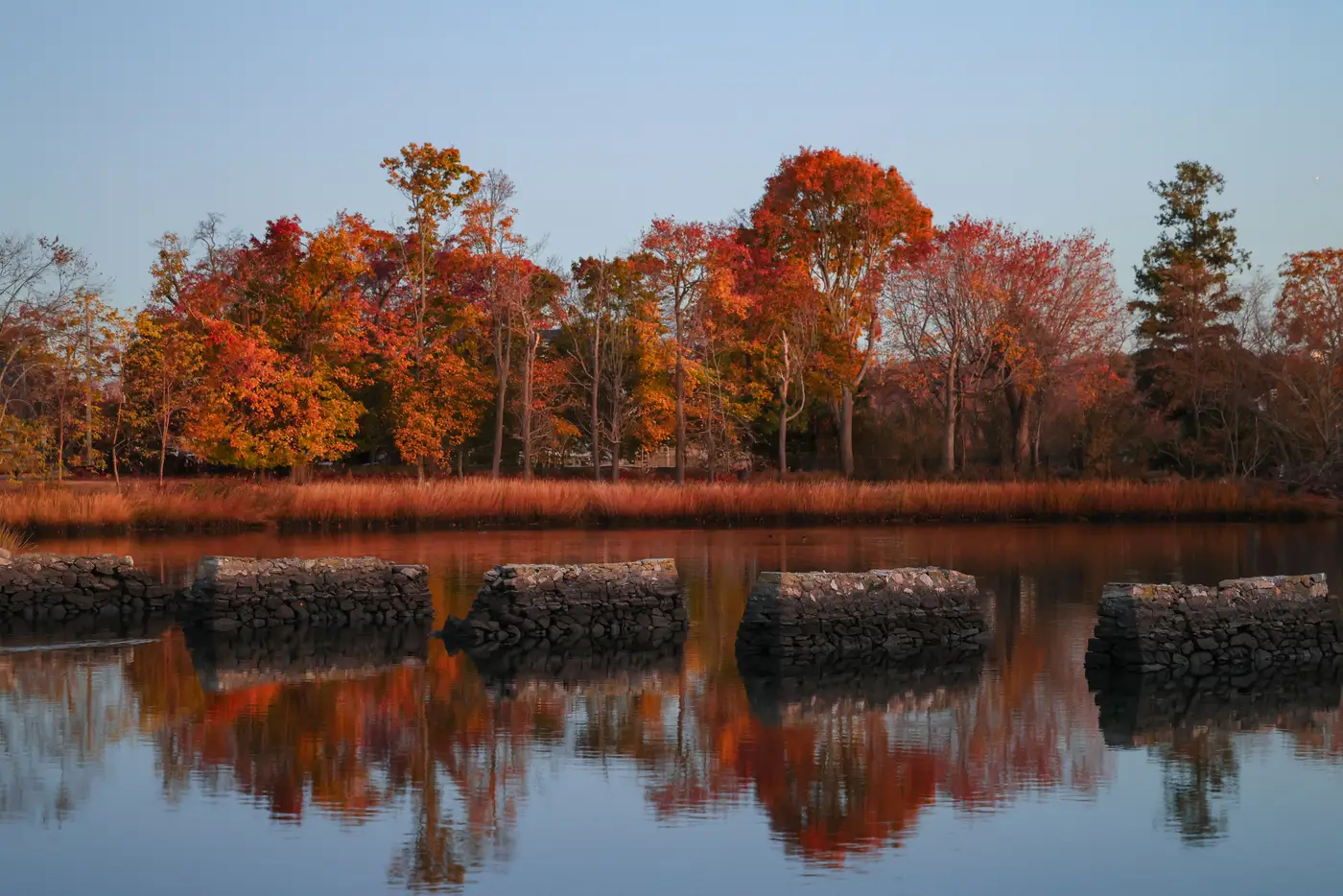
There's a cove on the east arm of our reservoir that every operator who's worked here longer than five years can tell you about without looking at a calendar. It greens up in the back third of October, give or take a few days depending on how cold September ran. Not the whole reservoir. Just that bay, with its shallow sill and the old creek channel that feeds it, cut off from the main thermocline by a ridge that holds the warm surface water in place until fall turnover finally mixes it down.
You learn a reservoir's habits the slow way, by being there for enough autumns that the pattern stops looking like coincidence. The first few years we treated each bloom as its own event. Pull samples, run the microscope, call it in to the state lab, wait. By year four someone on our team pinned the sample dates on a wall calendar and noticed the cluster. Second or third week of October, nearly every year, cyanobacteria counts in that bay climb past the point where we start watching the intake more closely. Once you see it, you can't unsee it, and you start asking why instead of just when.
The why, as far as we've worked out, comes down to stratification breaking down late in that cove specifically. The main basin turns over earlier because it's exposed to more wind fetch. The bay sits in the lee of a hill and holds its warm cap longer, which means the nutrients that settled out all summer get one more window of warm, sunlit, calm water before the whole system homogenizes for winter. It's a geometry problem as much as a water chemistry one. Change the shoreline, change the wind exposure, and the timing would probably shift too.
What we do with that knowledge now is less about surprise and more about staging. We know roughly when to tighten up our sampling frequency in that bay, when to flag the intake operators that we're heading into the window, and when to have geosmin and MIB testing ready to go rather than scrambling for lab capacity after the fact. The bloom still happens. What's changed is that we're not finding out about it the same week we're also fielding taste-and-odor complaints from the distribution side.
The harder years are the ones where the pattern breaks. A warm September pushes everything two weeks late. A storm mixes the bay early and the bloom that would have formed in the cove instead shows up diffuse across a wider stretch of the reservoir, lower concentration but closer to the intake line than we'd like. Those are the years the calendar on the wall doesn't help much, and you're back to watching the water itself rather than the date.
That's the part a fixed seasonal expectation can't cover on its own, and it's the reason a few of us have started looking at daily satellite passes over the reservoir rather than relying on sample runs and institutional memory alone. A tool that reads the bay's spectral signature as the bloom starts forming, before it's drifted anywhere near the intake, buys the kind of lead time that a monthly or even weekly sampling schedule can't. Algal Bloom Warning is built around exactly that gap, flagging bloom extent during the season so the surprise years look a little more like the predictable ones.
The bay will probably bloom again next year, somewhere in that same two-week window, because the ridge and the creek channel and the wind shadow aren't going anywhere. What matters is how much warning you get before it forms, and that's worth checking if your own reservoir has a bay that keeps its own schedule.